This week, I’m going to take things in a different direction and this introduction to it is rather long, but I hope people will bear with me. I mentioned before about my love for Heian poetry, and literature in general, and I want to take some time here to go more into that. (Yes, I promise there will be plenty of sexy pics upcoming! They seem to be popular and I certainly like doing them!)
“Genius” in my subtitle refers specifically to the woman poets and authors of Heian-era Japan. I’m writing this partly in an attempt to show what makes the work of these women geniuses so meaningful to me, but mostly because they seem to be so little known in our society. I think that’s a shame, not only because their work is supremely beautiful but because it’s so important. What these women expressed about love and life and loss cut right to the heart of our lives, a thousand years later and across a cultural gap that seems unimaginably vast, yet they bridge it—through time and distance and a language barrier that you’d think would be insurmountable. As yet, they managed it.
I’m going to try to give some hints here of why I believe they are so “relevant” today. (“Relevant” sounds pale and “buzzwordy” but it actually applies in this case.)
Robin’s Art and Erotica Nest is a reader-supported publication. To receive new posts and support my work, consider becoming a free or paid subscriber. 18+ Please!
I apologize for striking a negative note here (I’m sure that’s not what most people are coming here for), but in my “less joyful” hours (shall I say), I feel our civilization is in deep trouble. I think there’s multiple reasons for this, but I think the biggest one is that we live in a society that isn’t just unnatural, it’s anti-natural.
Nature is something we—as a society—do everything to avoid, to banish, to erase from our lives by every means possible. Pretty much every technology we’ve created has been created to that end. What passes for “nature” to the vast majority of us (especially if we live in an urban environment) is an artificial “Disney-fied” imitation of nature that bears little more relation to real Nature than a plastic plant does to a rain forest. Sure, we “love” and “support” nature… as long as it’s on video or behind glass. We even donate money do people so they can “preserve” it. But we don’t tolerate it well in our front yard (if we even have a front yard). No “preservation” there!
And no wonder. Nature is brutal. I appreciate that I don’t have to suffer from it the way my ancestors did. But our comfort and our safety (especially our “safety,” which we obsess about) come at a cost, and at some point, the costs outweigh the benefits.
This aversion is obvious in our arts, which are the “canary in the coal mine” of culture. (Does anybody still say that? Or were my parents the last generation where it was common?) “Modern” art, “modern” architecture, “modern” art-music, “modern” literature are all nearly devoid of nature themes. Popular culture (what little I know of it) is focused on what is “cool,” which changes faster than a humming bird’s heart beats. [Anti]Social media has cocooned millions in a “world” that exists only in the screen of whatever device they are glued to and can’t let go of.
And what’s the result? Anxiety and mental illness are at the highest point ever, especially among girls and young women, who are most vulnerable. True personal relationships (the real-life in-person kind) are in decline. Overall life satisfaction is at it’s lowest point ever.
In short, we live in a society that is becoming defined by alienation: from Nature, from each other, and from ourselves. If not corrected, that is not going to end well.
Again, apologies for the rant. But that is why I think Heian literature so important and so relevant. These women lived in a world where Nature, as brutal as it is, was embraced, not feared. Yes, it was sorrowful. Yes, it was often tragic and always poignant, but no less beautiful—all captured in a beautiful Japanese concept, aware, that I hope to explain (as best I can) at some point.
And we have so much to learn from them, if we’d only pay attention. In Japan, these women are still known (well-known in some cases), read and appreciated, but in our society, hardly anyone has the faintest idea who they are. The heyday of scholarship in Heian literature over here (the Anglosphere) seems to have been the 1960s. My impression is that it’s been declining since the 70s.1 That’s a shame in so many ways and a big reason I’m posting about this.
So now that I’ve wandered off-topic, what do I mean in my subtitle “The Crucible of Genius” and who were these women? I suppose I should start with some background on women poets of the Heian Era in general, and then later I’ll introduce you to some.
As I alluded to before, these women poets hold a unique place in history: the only literary “golden age” that was dominated by women. In fact, for the century or so represented by Murasaki Shikibu’s The Tale of Genji, all the notable Japanese poets and prose authors were women. The only vaguely similar time I’m aware of is the development of the novel in England in the late 18th and early 19th centuries: most of the novel writers were women, Jane Austin among them. But without disparaging Ms. Austin in the slightest, the literary heights attained in that age don’t match those reached by the women geniuses of Heian Japan.
This has raised questions in a way male accomplishment rarely does, but given its uniqueness, an explanation does seem to be wanted. One is that Heian court ladies simply had a lot of time on their hands and little opportunity to use it. There is something to this; these ladies did avidly read a genre of tales—mostly written by men—to entertain themselves in their circumscribed lives. But this kind of “enforced leisure” has been the lot of many high-born women through the ages, and at no other place and time did it result in such an efflorescence of literary genius.
A more plausible explanation, put forth by Ivan Morris and other scholars, is that Heian women wrote in Japanese vernacular using a relatively new script that rendered their language phonetically. Men wrote in Chinese, which was not socially acceptable for women to learn, although no small number knew at least a little. Because women were (in theory) limited to the vernacular, the script was known as “women’s writing”; Chinese being “men’s writing.” Interestingly, a similar thing happened in art, where a new painting style developing at that time was called “women’s painting” while the traditional Chinese style was considered male.
Both “women’s writing” and “women’s painting” were freer, more vibrant styles than the formal Chinese styles men strove to emulate. Women were thus allowed to express themselves in ways men were not supposed to, leading to the interesting phenomenon of men adopting female personas when they wrote in the new script. This happened with men’s diaries written in the vernacular; their diaries were supposed to be in Chinese so they would begin by saying something like “a woman will now try her hand at writing a diary” to give themselves cover.
We can appreciate the stultifying effect of Japanese men stuck copying Chinese literary forms in a language not their own. I might imagine that if men today were required to compose only hexameter poetry in Homeric Greek, the results would be derivative and clichéd. Yet, freedom from the constraints of foreign modes and methods and the ability to express themselves naturally in their own language, while an aid to genius, does not on its own create it.
To put it more simply, very few poets or prose authors—men or women—in the last 1000 years have approached the levels these Heian women achieved; maybe none. Something else also happened here. What that could be is obscure, as the wellsprings of genius always are. I might guess that a society so deeply in tune with nature and highly valuing an elevated and refined aesthetic would cultivate genius where it existed. The relatively high status accorded to women in Heian Japan, compared to what would come later (both in Japan and elsewhere) could be a factor. And, of course, genius begets genius (as the example of ancient Greece, especially Athens, shows) and these women being in constant, intimate contact would seem to encourage its development.2
Perhaps, ironically, the cloistered existence of these court ladies in a society where aesthetic discernment was paramount, giving them ample time and occasion (perhaps too ample, as far as their personal happiness was concerned) to explore all the vagaries of the human heart and experience them fully, undistracted, with all the honed sensitivity of their society, in the close company of like-minded and like-gifted women, created the “perfect” environment for this flowering of literary genius.
If so, it came at great personal cost. We should appreciate their work all the more for that.
The period these women spanned was great—much longer than the Heian era; nearly a thousand years, in fact. The earliest female poet of note I’m aware of is Empress Iwa no Hime, the empress consort of Emperor Nintoku (he reigned 313-399). They were said to be very much in love and to have written many poems to each other.
The latest were Princess Shokushi (1149-1201) and Shunzei’s Daughter (around 1200), two of the most important poets of their day. They were the last two clear, brilliant, deeply moving voices of a shining era, the like of which we have never seen again.
In between, we have several important women from the Nara court in the 8th century, and the legendary (and controversial) Ono no Komachi who was a lady of the imperial court in the mid-9th century, and a pivotal person in the history of Japanese poetry.3
The apogee was reached in the Imperial court when Fujiwara no Michinaga ruled Japan for almost three decades, starting in 995 (not as emperor; the emperor was just a figurehead at that point, controlled by the Fujiwara clan). During these years the Tale of Genji was written by Murasaki Shikibu, The Pillow Book by Sei Shōnagon, as well as the poetry of Izumi Shikibu, Akazome Emon, Ise no Tayū and other notable women.
Our literary canon has its share of geniuses, starting with Homer and Sappho, and including Shakespeare and whoever else you like. But they are separated by thousands of years and come from widely different cultures. All these women—who are the equals (at least) of any literary figure in our history (or any other)—all lived under the same roof at the same time and knew each; some were friends, some (it is supposed) were rivals. But they were together, almost like family.
To me, that is the most incredible thing that has ever happened in human history. So please bear with me as I do what little I can to introduce these amazing women. Maybe I won’t be anymore successful than that book I got from a library shelf where it had been collecting dust for who knows how long? But at least I will have tried.
If you’ve read this far, thank you more than I can say! You have rare patience! 😊
I think that deserves a reward, so leave a comment and I’ll comp you a 30-day paid subscription. Hopefully, in the next month I’ll post more things you enjoy, if Heian literature isn’t quite your cuppa (as one of my friends says).
I got a standard reference on Heian literature from a college library, and as near as I could tell, it might not have been checked out in over 50 years! That’s based on the last date stamped on the check-out slip inside the front cover. Of course, they obviously went to an electronic system at some point and would’ve stopped stamping the slip, but that’s still a really long time between people checking it out. And that’s not the only example of a book I borrowed that still had a check-out slip that hadn’t been used in decades. So sad…
“Intimate” sound like a loaded term, I know. Yes, they lived together at close quarters and they also often exchanged poetry containing expressions of love. Scholars say this was conventional at the time and shouldn’t be taken as a sign of romantic, sexual attachment. But did they love each other, romantically and sexually? Almost certainly. Scholars also admit as much. That has a contradictory ring to it: it seems scholars are saying we shouldn’t read too much into the poetry woman exchanged, but then yes, maybe we should. However, both things can be true. The convention expressing what sounds like love and longing can just be like the salutation “Your obedient servant…” when you are anything but, or it could be sincere and the privacy gained was a valuable thing.
Also, the conventions surrounding the love affairs between women and men (which were pretty strict and I’ll talk more about them at some point) all depended on (and reflected) the fact that men and women were kept segregated in their daily lives and interacted only at a distance or with some physical barrier behind them. (Usually a screen, sometimes translated as a “screen of state.”)
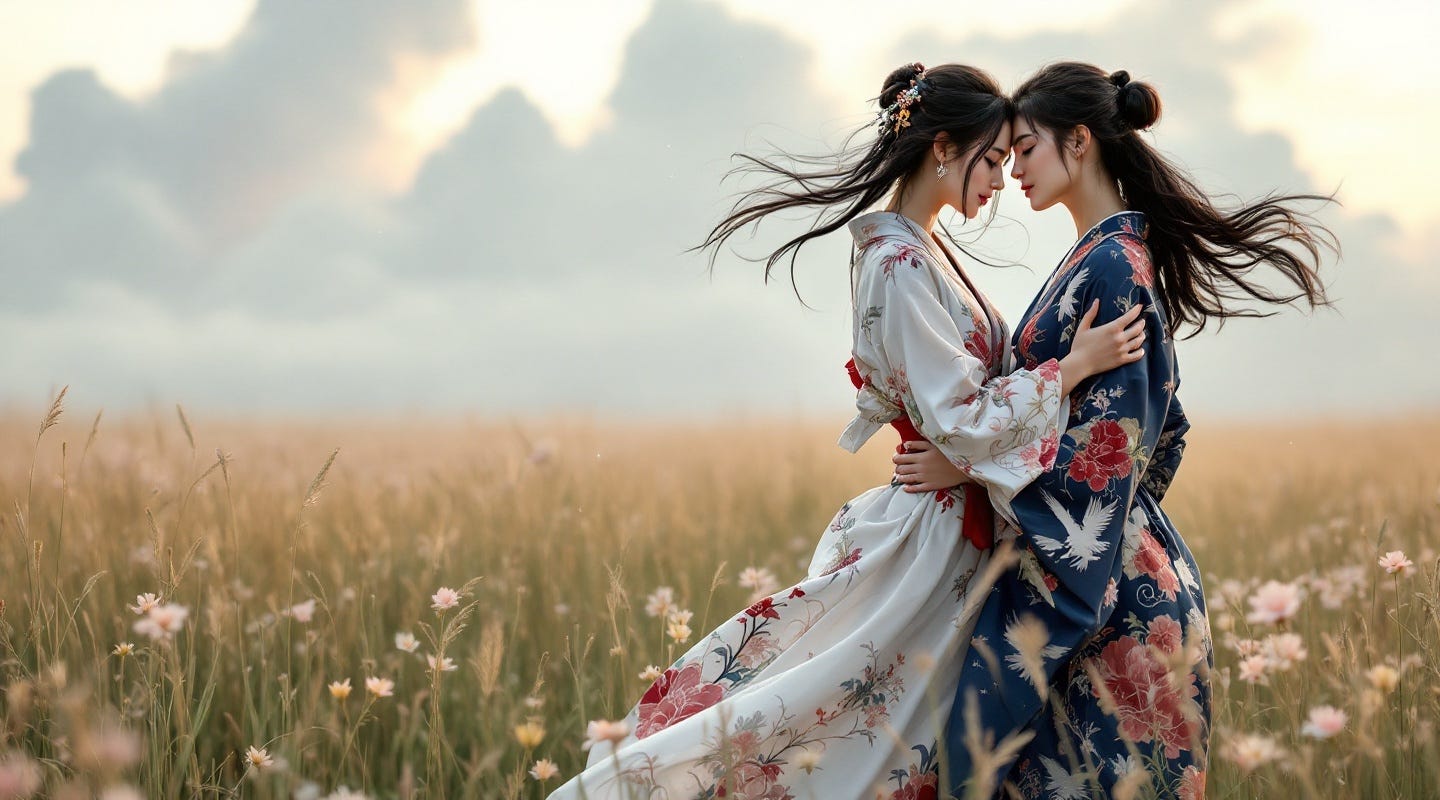
But since women all lived together, there was no need for “clandestine” coming and goings. (I put “clandestine” in quotes because that was one of the conventions: affairs were always “secret” until formally acknowledged, even though people had a pretty good of who was hooking up with whom. Of course, there were affairs that were actually secret too, and some could last a long time.) So we can imagine that women’s love for each other was not bound by all the same societal rules that governed romance between women and men.
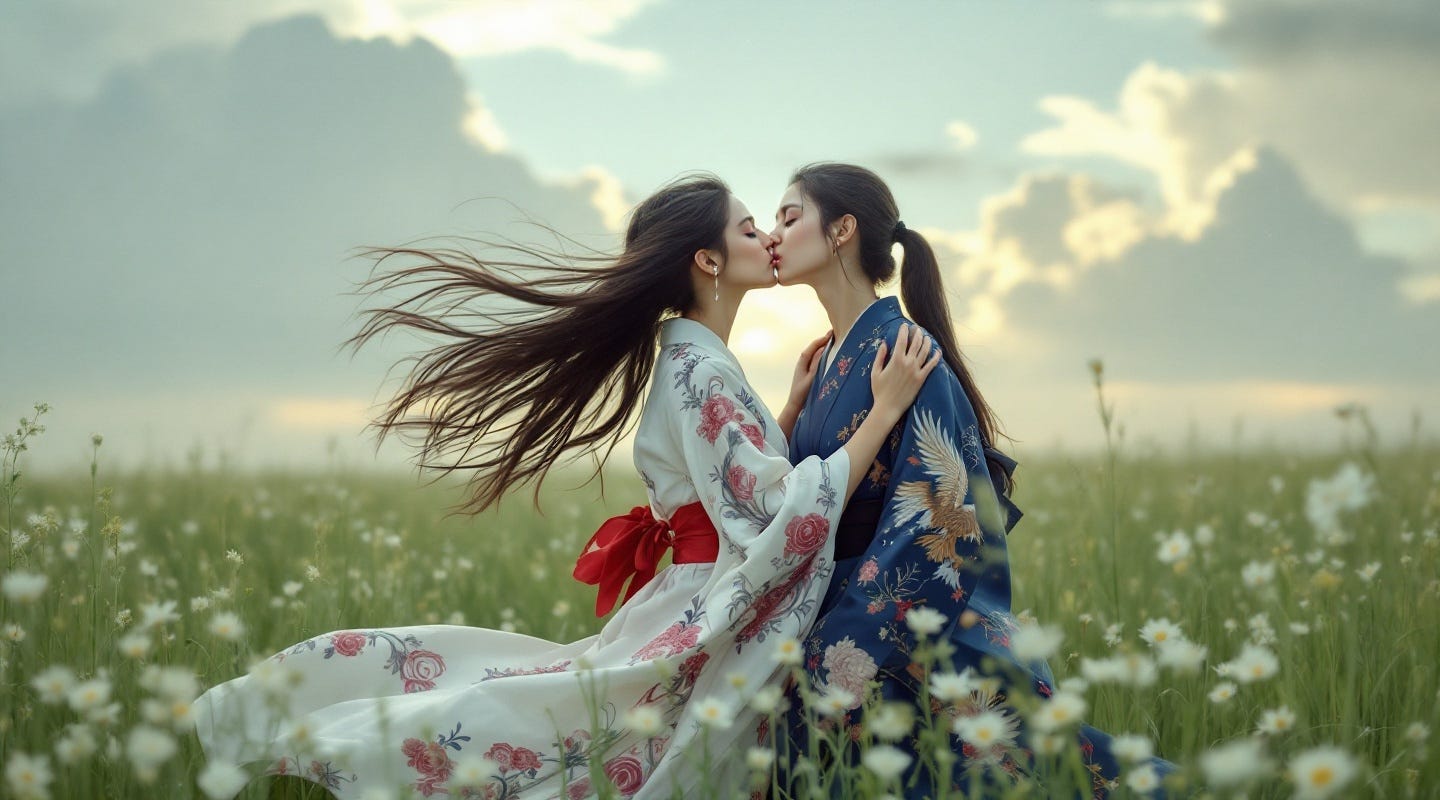
The main thing, however, is that love and sex were viewed quite differently than our society does (much less prudish!) and the spirit of Sappho was not absent from the Heian imperial court. I’ll have more to say about that, but this another reason (as if another is needed) we should appreciate these women all the more!
Ono no Komachi remains a well-known figure in Japan today. In some ways, her reputation reminds me of how Helen of Troy is viewed by us. But that’s a topic for another day (if ever).