Japanese poetry in general, and Heian poetry especially isn’t much like the poetry most of us are used to. Also, because of its unique nature, the translation of any one poem into English can vary so much that we can be forgiven if we don’t first recognize we’ve reading the same one. Reflecting on this, Ivan Morris said Heian poetry was the most challenging all of work to translate. I think translating any poetry is extremely difficult, but I don’t think he was wrong. So I thought I should try to present some kind of introduction to Heian poetry before launching into the women poets I’m going to introduce.
I’ve tried to get the basics right, but I’m not a true scholar and someone who is would probably find many faults in my introduction. But despite my faults, I’m hoping this will at least give readers some idea of what the poetry of that era is like and what makes it so special.
Here goes… (And I’ll resume posts for paid members tomorrow. Thank you for your patience! 😊)
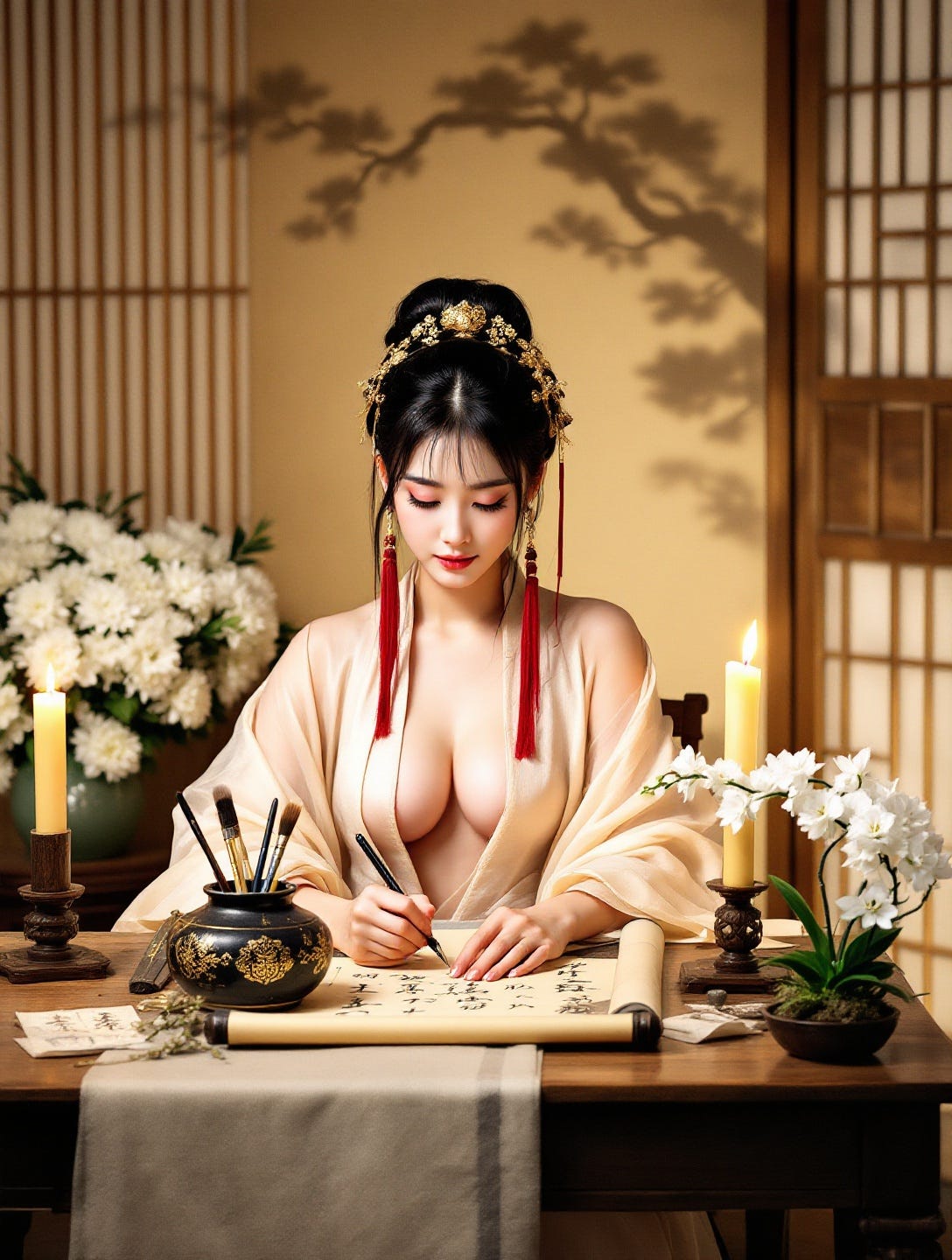
Almost all Heian poetry was tanka (short songs), which supplanted choka (long songs) and the other forms of Japanese poetry early on, and remains popular today. So admired was tanka that the other forms are rarely encountered after the latter part of the Heian era and some disappeared entirely. It was not until the development of haiku, centuries later, that another poetic form achieved a similar level of popularity.
Tanka (or waka; the terms are basically synonymous) is a 31 syllable poem of five lines with the metrical form of 5-7-5-7-7. Haiku, which is much more familiar to us, has the same structure as the first three lines of a tanka poem, but it didn’t develop directly from tanka but from renga, Japanese linked verse. That however is another story.
As an aside, all Japanese verse forms are a composed of five and seven syllable lines, lines being a notional term because Japanese poetry was written without physical line breaks. A line, therefore, is either five or seven syllables, followed by another five or seven syllables and so on, according to the type of verse.
Tanka, however, is not characterized merely by its metrical form. By convention, tanka relates a natural occurrence to a deeply felt human emotion. The main purpose of tanka is to relate that which is most important, keenly felt and central in our lives to Nature (with a capital N). The most prominent themes in tanka tend to be love, loss, and longing; the sorrow of having to leave or be away from a loved one; overall, the fragility and evanescence of life, reflecting Buddhist influence. A kind of mournful joy in the deep appreciation of transient beauty is characteristic of tanka. However, poems in praise of sake, flirting with fishing girls, teasing prospective suitors or making a pointed retort are not uncommon. Because poetry was the medium through which virtually any kind of interaction could be mediated in the Heian court, tanka covered all of these things. The brevity and flexibility of tanka made it well suited to a whole range of purposes.
Next, tanka makes extensive use of “pillow words” (the Japanese term is makurakotoba). Scholars note that pillow words are similar to Homeric epithets like “rosy fingered dawn” or the “wine dark sea”; they serve to enhance a noun and many are (as in Homeric poetry) conventional and thus appear over and over. Pillow words are often problematic for translators because many of them are quite ancient—some were already archaic in the Heian period, over 1000 years ago—and their meanings have been lost. Others refer to things that are specific to Japanese culture and opaque to others (much as some idiomatic American speech greatly puzzles non-Americans). But dispensing with pillow words can easily render a translation flat and banal. The best translators are able to convey the sense of a pillow word through a word or phrase that while not literal has a similar poetic effect.
Thirdly, tanka employs what are called pivot words (kakekotoba). These are words that have a dual meaning which links the two parts of the poem: the natural occurrence and our human emotion. Genius poets, like Ono no Komachi and Izumi Shikibu, use pivot words to extraordinary effect. They allow them to express a great wealth of meaning in just a few syllables.
Finally, tanka can be heavily allusive. Allusions to other poems, typically classics well-known to the audience or recipient, accomplish several things. They may heighten the feeling of the poem by association with the emotional content of the other work; they can act as a kind of shorthand for an event, bringing to mind it and its repercussions; and they demonstrate the poet’s literary knowledge, which was important in Heian court circles, both socially and for professional advancement.1

Because of these features, Heian poetry can appear formulaic, even repetitive, especially in translation. Translation has a hard time capturing the many nuances of the original language. Poems were also often composed on standard themes, especially for contests, thus full of stock phrases, and lines from other poems could be repeated nearly verbatim.
As translator and poet Jane Hirschfield points out, this style (called honkadori in Japan) is not plagiarism. The concept of originality, as we understand it, is a fairly modern one. What mattered to the Heian poets (and to poets of other cultures, including ancient Greece, for that matter) was not inventing wholly new material, but the effective and eloquent use of the vast wealth of literature known to them and their audiences. Employing elements of this tradition in new contexts was more important than inventing new work, although that certainly happened as well.
That is not to say that a great deal of Heian poetry wasn’t trite and colorless. While composing poetry was a requirement for being a member of the Imperial Court, not everyone at court was a poetic genius and undoubtedly a good deal of it was uninspired and uninspiring.
Perhaps what is more important though, was the attempt. It may be suspected, as scholars such as Ivan Morris have, that much of the time, writing poetry was a rather proforma exercise the gentleman of the court, in particular, did not really have their heart in. It was simply necessary to get along in their society, rather like wearing ties to a business meeting.
But, like wearing proper business attire to a meeting to make a good impression, there is value in maintaining the forms of that which is valuable. In this sense, composing pedestrian or jejune poetry is better than composing no poetry at all. By supporting the forms, the Heian courtiers supported the substance: a heightened sensibility that connects us with the natural world, and thus with each other.
Tanka arguably does this more adroitly than other poetic forms. While it has some stylistic similarities to American free verse (which is therefore the most apt to translate it, to the extent that’s possible), it reflects and conveys this particularly Japanese sensibility.
Western literature was born out of epic poetry (and one epic poet in particular) which employs a vast, grand sweep to take the listener on a long epic voyage spanning all realms of human experience, from the brightest fields of endeavor to the darkest corners of our minds.
The best tanka achieves a similar effect by doing the exact opposite. In 31 syllables, it focuses on a single event at a specific moment that, through the artful use of pivot words and allusions, expands into a myriad of profound connotations. In a beautifully paradoxical way, tanka crystallizes a moment to allow it to unfold in our minds, as we contemplate it in the silence that follows the final syllable.
I think of tanka as being more like a perfect pearl being dropped into a still pond. The poem is the splash the pearl makes; the ripples are the ramifications we are invited to contemplate as they spread across the surface, catching the light and giving us tiny, rainbow-hued flashes of insight.
To me, the “secret” of Heian love poetry is the deep appreciation of, and I would say love for, Nature that is central to it. To appreciate the sunrise or sunset, the cherry blossom, the scent of plum, the dew on a rose petal, the silence of falling snow, the rain’s pure kiss, and even the savagery of a thunderstorm or the ocean at the height of her rage, opens us to the full depth and breadth of feeling; the full dimensions of delight we may find in loving one another. This dimensionality is the difference between lasting love and transient lust, and it is a sensibility that is not much in evidence in our current society. Of course, it is not helped by the Western Christian tradition that (as I talked about in my previous post) places man in opposition to Nature, not in harmony with her. Lack of harmony with our world is tantamount to lack of harmony with each other, and even lack of harmony with ourselves, and we’re all paying the price for that.
Ki no Tsurayuki, who wrote the preface to the Kokinshu around 905, the first of the anthologies commissioned by imperial writ and one of the most revered Japanese poetry collections (along with the Manyōshū, which did not have imperial sponsorship), expressed this more eloquently and succinctly than I ever could when he said:
“The poetry of Japan has its seeds in the human heart and mind and grows into myriad leaves of words. … It is poetry which effortlessly moves the heavens and the Earth, awakens the world of invisible spirits to deep feeling, softens the relationship between men and women, and consoles the hearts of fierce warriors.”
I could not agree more. To read Heian poetry is to recapture some sense of that sensibility and that, I believe, can never be labor lost.
For anyone who wants to learn more about life at the Heian court, The World of the Shining Prince: Court Life in Ancient Japan by Ivan Morris is the standard work. For those who wish to explore more Heian poetry, I recommend the following books; all have been invaluable to me in my own explorations.
The Ink Dark Moon: Love Poems by Ono no Komachi and Izumi Shikibu, translated by Jane Hirshfield and Mariko Aratani. Random House, 1990. Hirshfield’s introduction is a must-read for understanding the context in which these poems were written.
Ten Thousand Leaves: Love Poems of the Manyōshū, translated by Harold Wright. The Overlook Press, 1986.
An Introduction to Japanese Court Poetry, translated by Earl Miner and Robert H. Brower. Stanford University Press, 1968.
Kokin Wakashu: The First Imperial Anthology of Japanese Poetry, translated by Helen Craig McCullough. Stanford University Press, 1985.
For Heian prose, my preferred version of The Tale of Genji is the unabridged translation by Dennis Washburn. Both Penguin Classics editions of The Pillow Book, translated by Meredith McKinney and Ivan Morris respectively, are also excellent.
As always, I cherish your thoughts and your support means the world to me!
In fact, Sei Shōnagon, in her Pillow Book, often mentions how an everyday conversation could hinge on some poetic quotation. Rather that make a pithy or pointed retort, or a complimentary observation as we tend to so, a Heian aristocrat was more likely to quote a line of poetry and the recipient would respond with another line from the same poem or a line from another poem that was related. Extra points were given if the poems was Chinese (kind of like scholars who used to quote Latin and Greek or Hebrew at each other).
This may feel pompous to us, because of unfortunate associations with academic snobbery, but in Heian court society it was polite and looked on as we tend to admire a person who is witty, charming and well-spoken. It’s important not to let our preconceived notions trip us up over things like this.